

 1-877-999-8489


2026
Why Distribution Keeps Expanding Into Calgary East and Rocky View County
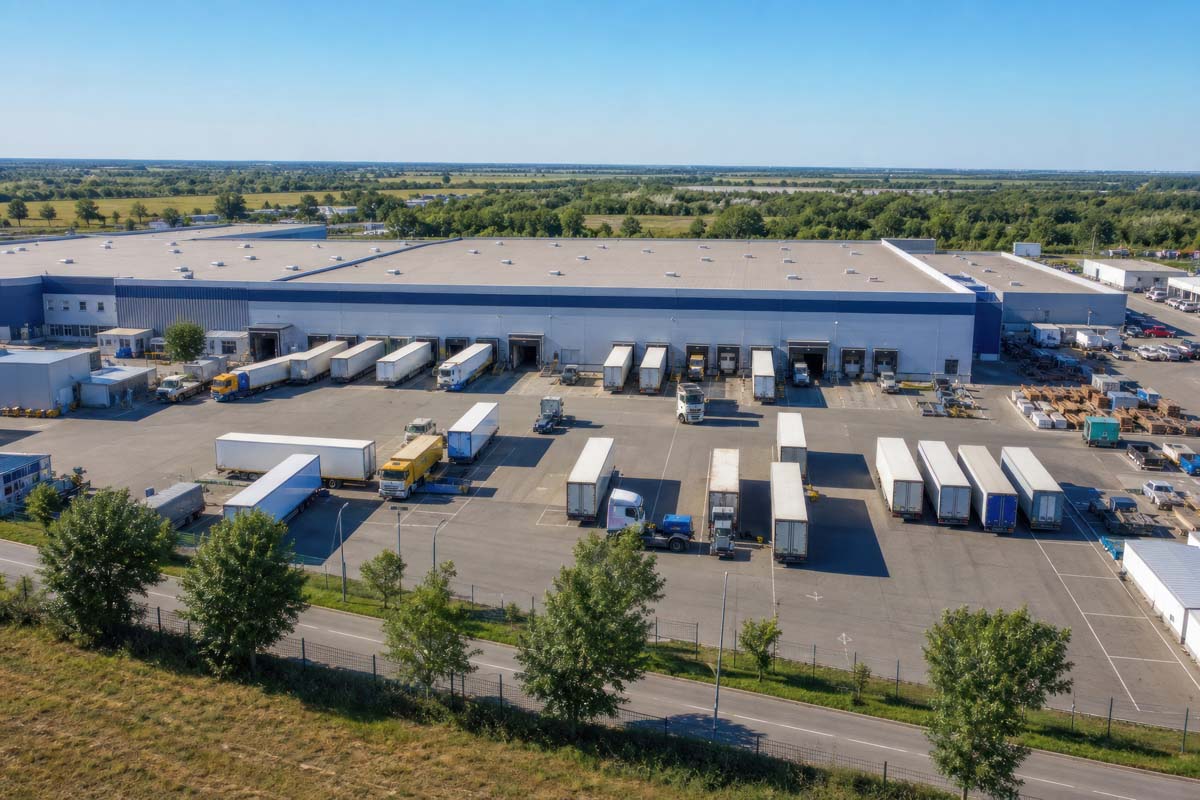
Drive east out of Calgary on any of the main routes and the pattern is hard to miss. Fields that were farmland a decade ago now carry concrete tilt-up buildings with deep truck courts, and more of them are going up.
It is not a coincidence or a land speculation story. Calgary has become the distribution centre of western Canada for reasons that are almost entirely geographic and infrastructural, and the specific push eastward into Rocky View County follows from what modern distribution buildings need and where that can actually be built.
Calgary Sits Where the Freight Has to Pass
The starting point is position. Calgary sits on the Trans-Canada Highway, is served by both national railways, and lies between the west coast ports and the population centres of the Prairies and central Canada.
That matters because of how far a truck can travel in a day. From Calgary, a driver reaches Edmonton, Red Deer, Lethbridge, much of the British Columbia interior, Saskatoon, Regina and a considerable slice of Montana and Idaho inside a single shift. Winnipeg and the Lower Mainland are reachable in two. There is no other city in western Canada that covers as much population and as many industrial customers from one building.
For a national brand that cannot justify separate facilities in every province, that reach is the entire argument. One Calgary distribution point serves the west at a service level that shipping from Ontario cannot match and at a cost that a Vancouver facility struggles to compete with.
Rail Made It an Inland Port
The second factor is intermodal. Containers arriving at the west coast move inland by rail and come off the train in the Calgary region, which makes the city a functional inland port rather than simply a highway crossroads.
Both national railways operate logistics facilities in the Calgary area, and the surrounding industrial land has developed around them. For an importer that means a container can move from a vessel to a Calgary warehouse without a truck crossing the Rockies, which is cheaper and less exposed to the corridor closures that periodically interrupt road freight through the mountain passes.
It also explains the geography of the industrial growth. Distribution follows rail access and highway access, and the land where both are available in quantity is on the city's edges rather than inside it.
The Ring Road Changed Which Sites Work
The completion of the ring road around Calgary is the single most underappreciated factor in where distribution has located.
Before it, freight moving from one side of the city to the other went through the city, which consumed driver hours and made delivery times dependent on traffic. With a continuous ring, a truck can circle Calgary and reach any quadrant without crossing it. A site on the eastern edge is now effectively connected to the northwest, the southwest and the airport, which it was not in the same way before.
The practical consequence is that the premium for being centrally located has fallen. A building on the eastern side of the city with direct ring road and highway access can serve customers across the region as well as a more central site, without the land cost and the congestion that come with being hemmed in.
Modern Buildings Need Land That Only Exists on the Edge
A distribution building constructed today looks nothing like one from the 1980s, and the differences are all about space.
Current standards call for high clear heights to allow deep racking, wide column spacing, large numbers of dock doors, deep truck courts so that a tractor trailer can manoeuvre without blocking the next one, trailer parking, and substantial yard area. Add the electrical capacity that increasingly matters for refrigeration and automation, and the result is a building footprint and a parcel size that simply cannot be assembled on infill land inside an established industrial area.
Rocky View County and the eastern edge of the city have the large contiguous parcels that allow it. That is why the growth has gone there, and why the buildings going up are large rather than numerous.
What the County Brings
Rocky View County has been among the faster-growing municipalities in Alberta, and industrial development has been a substantial part of that growth.
For a business locating there, the advantages are reasonably concrete. Land and lease rates are lower than comparable space in Metro Vancouver by a wide margin, and lower than much of the GTA. Alberta has no provincial sales tax, which simplifies some aspects of operating and purchasing. The labour pool draws from Calgary itself along with Chestermere, Langdon and Strathmore, which puts a workforce within a reasonable commute of sites that look remote on a map.
And the surrounding industrial base matters. Energy services, agriculture and food processing, building products and manufacturing all generate freight in the region, so a distribution facility there is near both its customers and its suppliers rather than only near a highway.
The Honest Constraints
None of this means the eastern corridor is uncomplicated, and the drawbacks are worth stating plainly.
Industrial land values in the Calgary region have risen considerably, and availability of good serviced parcels is tighter than it was. Utility servicing in the county can take longer than inside city limits, which affects development timelines rather than operations. Winter is a real operational factor: yards need clearing, docks need managing, and freight that would be fine outdoors in Vancouver is not necessarily fine here. And the labour market for warehouse staff is competitive, with the energy sector drawing from the same pool.
Those are the trade-offs. They have not slowed the trend, but they do mean a business choosing a location should be looking at the specific site and the specific operator rather than assuming the region solves the problem.
What It Means If You Ship Into the West
For a business weighing where to hold western inventory, the useful conclusions are fairly simple.
Calgary covers more of western Canada in a day's drive than any alternative. Intermodal access means imported goods can reach the city without a road crossing of the mountains. Cost of space is materially lower than on the coast. And the eastern corridor is where the buildings with modern specifications and real yard capacity actually are.
It is also why our own Calgary facility is where it is. Pacific Coast Distribution operates from 510 Carmek Blvd SE in Rocky View, with 60,000 square feet of SQF and HACCP certified ambient warehousing, an eight acre secured property, and our own transportation fleet on the same site.
Talk to Us About the West
We have been handling warehousing and freight since 1999, from Langley and Calgary, across the market sectors that move the most volume in this region including food, beverage, consumer packaged goods, healthcare and beauty.
If you are looking at a western distribution point, tell us where your customers are and what you ship, and we will give you an honest read on whether Calgary is the right base for it. Call 1-877-999-8489 or request a rate quote.