

 1-877-999-8489


2026
Regional Transportation Advantages: Serving Alberta and BC from One Calgary Base
Ask a distributor why they run two warehouses in Western Canada and the answer is usually about service levels. One building near Vancouver for the coast, one near Calgary for the prairies, because customers expect next-day delivery and nobody believes a single location can cover both.
That belief made more sense fifteen years ago than it does today.
The distance between Calgary and Metro Vancouver has not changed, but the economics around it have. Industrial rents in the Lower Mainland remain among the highest in North America while Alberta space costs a fraction of that. Fleet capacity on the corridor has improved. And for a large share of Western Canadian shippers, the volume genuinely does not justify two sets of racking, two management teams, and two inventory pools.
Here is how a single Calgary base actually performs against BC and Alberta demand, including the cases where it does not.
Calgary Sits Where the Freight Already Goes
Calgary's advantage is not that it is central on a map. It is that it sits on the intersection of the routes that Western Canadian freight already uses.
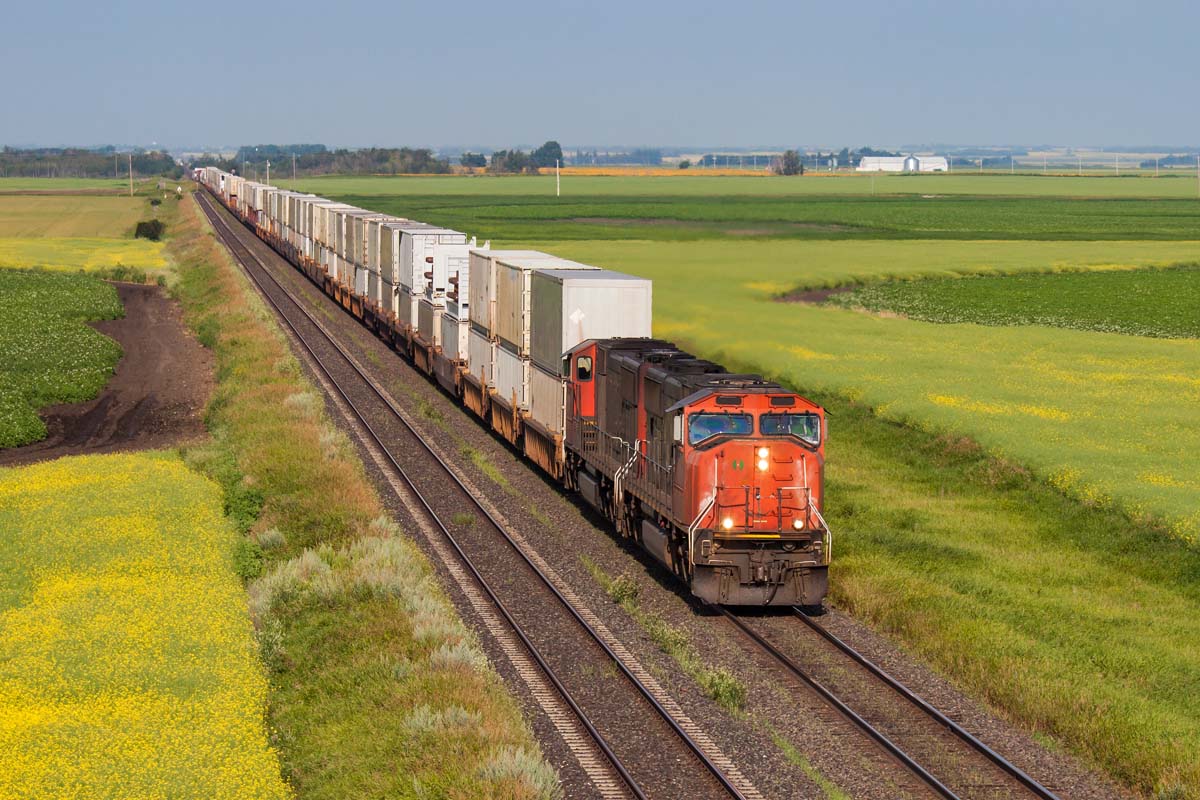
The Trans-Canada Highway runs west to the Lower Mainland and east across the prairies. Highway 2 and the QE2 corridor connect Edmonton to the north and the Montana border to the south, forming the Canadian leg of the CANAMEX trade route. Stoney Trail closed the ring road, which means trucks reach the industrial areas in Rocky View County and the southeast without fighting through city traffic. Both Class 1 railways serve the region, and the airport handles significant air cargo volume.
Practically, that means a truck leaving southeast Calgary can reach Edmonton in roughly three and a half hours, Red Deer in under two, Lethbridge in about two, and Saskatoon within a working day. Kelowna and the Okanagan are a comfortable single-day run. Metro Vancouver sits at roughly ten to eleven hours of driving, which is a next-day delivery on a standard departure and a same-day possibility on a team run.
None of that requires a second building. It requires a fleet that runs those lanes consistently and a warehouse positioned to load early. Our regional transportation service exists precisely because those lanes carry enough of our customers' freight to run them as scheduled capacity rather than as one-off bookings.
The Rockies Are a Planning Problem, Not a Reason to Avoid the Lane
Anybody who has moved freight between Calgary and Vancouver in January knows the corridor has a personality.
Highway 1 through Rogers Pass, the Coquihalla, and Highway 3 through the Crowsnest all close periodically for weather, avalanche control, or incidents. The 2021 flooding demonstrated how badly the corridor can fail when several routes go at once. Pretending otherwise is not a transportation strategy.
But treating that risk as a reason to duplicate your entire footprint is an expensive overreaction. The corridor closes for hours or days, not weeks, and it has three viable routes rather than one. What it actually demands is planning discipline: building winter transit variance into your published lead times, holding a small buffer of BC-destined inventory during the worst months, and working with a carrier that has drivers who know the passes and dispatchers who reroute before a closure becomes a missed delivery.
An asset-based fleet matters more here than anywhere. When weather compresses capacity across the corridor, brokered freight competes for whatever trucks remain. Owning the equipment means your load is a scheduling decision rather than a bidding contest, and it is why our FTL service runs on our own trucks rather than a network of subcontractors.
Do the Math on Two Buildings Before You Commit to Them
The honest comparison is not Calgary versus Vancouver. It is one facility plus longer linehaul versus two facilities plus duplicated overhead.
Two buildings cost you more than double the rent. You carry safety stock twice, which ties up working capital that would otherwise fund growth. You split your inventory pool, which means the SKU a customer wants is sometimes in the wrong province. You run two management teams, two sets of certifications, two WMS configurations, and two labour pools in markets that are both competitive for warehouse staff.
Against that, one facility carries higher outbound freight cost per BC order and a longer lead time to coastal customers.
For most mid-sized distributors, the single-facility model wins until BC volume gets large enough to fill dedicated trucks several times a week. That threshold is the number worth calculating. Below it, consolidating into Calgary and paying for linehaul is cheaper and simpler. Above it, a second node starts to pay for itself.
There is also a middle path that gets overlooked. Consolidating BC-bound orders into full truckloads and breaking them down at destination captures most of the freight savings of a local warehouse without any of the fixed cost. Our LTL and consolidation options exist for exactly that pattern, letting smaller shippers share capacity on lanes they could not fill alone.
Where a Single Base Genuinely Falls Short
It would be dishonest to pretend the model works for everyone.
Time-definite delivery inside Metro Vancouver, where customers expect a morning window rather than a next-day arrival, is difficult to serve from Alberta. Short-shelf-life perishables lose too much of their window in transit. Importers moving high container volumes through the Port of Vancouver often benefit from destuffing near the terminal rather than paying to drag ocean containers inland. And any business whose BC revenue substantially exceeds its prairie revenue is simply positioned in the wrong province.
If you fall into one of those cases, the answer is a coastal presence. What we would push back on is the assumption that every Western Canadian distributor falls into one of them, because most do not.
Talk Through Your Own Numbers
The right footprint depends on your order profile, your product, and where your customers actually sit. That is a specific calculation, not a general rule.
Pacific Coast Distribution has been moving and storing freight for Canadian manufacturers since 1999, with warehouses in Langley and Calgary, HACCP and SQF certification, and our own fleet running the Alberta and BC lanes. We can tell you fairly quickly whether one base covers you or whether your volume has outgrown it.
Request a rate quote and we will run the comparison against your real shipment data.