

 1-877-999-8489


2026
How LTL Shipping Saves Calgary SMBs Money Without Sacrificing Speed
Most small and mid-sized businesses in Calgary discover less-than-truckload shipping the same way: they have four pallets to move, they call around for a truck, and the quote comes back at a number that makes no sense for the amount of freight involved.
That reaction is correct. Paying for a 53-foot trailer to move four pallets means paying for roughly 40 feet of empty air. LTL exists precisely to solve that, and it is usually the right answer well past the point most businesses assume.
What You Are Actually Paying For
With a full truckload, you buy the truck. The price covers the equipment, the driver and the lane, and it is the same whether the trailer is packed to the doors or half empty.
With LTL transportation, your freight shares trailer space with other shipments and you pay for the portion you occupy. The pricing is driven by weight, by the space the freight takes up, and by how far it is going. A business moving two to six pallets at a time is almost always better off here.
The density point is the one that catches people out. A pallet of canned beverage and a pallet of empty packaging weigh very different amounts but occupy the same footprint, and LTL pricing accounts for both weight and dimensions. Freight that is light and bulky costs more per kilogram than the scale alone suggests, which is why accurate dimensions matter as much as accurate weight when you request a quote.
The Speed Objection, and Why It Is Often Wrong
The usual argument against LTL is that it takes longer. Freight moves through terminals, gets consolidated with other shipments, and makes stops along the way, so transit time is less direct than a dedicated truck running point to point.
That is true as far as it goes, and it matters on long cross-country lanes. On regional Alberta and Western Canada runs it matters considerably less. The distances are short enough that a well-planned LTL shipment frequently arrives on the same day a truckload would, and on scheduled lanes it is entirely predictable.
There is also a speed cost on the other side of the ledger that rarely gets counted. Waiting to accumulate enough freight to justify a full truckload is itself a delay. A business that holds orders for ten days so it can fill a trailer has delivered nothing for ten days. Shipping twice a week by LTL gets product to customers faster even if each individual transit is marginally longer.
Where LTL Costs Quietly Inflate
LTL pricing is transparent until it is not. Most unpleasant invoices come from a short list of avoidable causes:
- Dimensions or weight declared at booking that do not match what shows up, triggering a reweigh and a corrected bill
- Freight that is poorly stacked or overhangs the pallet, so it cannot be loaded under another shipment and gets charged for the space above it
- Liftgate service at a destination with no loading dock
- Residential or limited access delivery charges
- Appointment delivery, inside delivery, or notification requirements added after the fact
- Storage charges when a consignee cannot receive on the scheduled day
- Shrink wrap that fails in transit, leading to damage claims and reshipment
None of these are the carrier being difficult. They are real costs created by the shipment itself, and most are fixable in the warehouse before the freight ever leaves.
Practical Ways to Bring the Rate Down
The levers available to a smaller shipper are more substantial than most realize. Several make a measurable difference:
- Measure and weigh every shipment properly rather than estimating from last time
- Build tight, square pallets with nothing overhanging the edges, and stack to a consistent height
- Consolidate several small customer orders heading to the same region into one shipment
- Offer flexible pickup windows, since fixed narrow windows cost money on every lane
- Deliver to commercial addresses with docks wherever the customer can accommodate it
- Keep documentation accurate, because corrections mid-transit are expensive
- Work with one provider consistently rather than spot-quoting every shipment, so your freight profile is understood
The Warehouse Changes the Maths Entirely
This is the part specific to businesses selling into Alberta from somewhere else, and it is where most of the savings actually sit.
If your inventory lives in British Columbia or Ontario, every Calgary order becomes a long-haul shipment. If your inventory lives in Calgary, the same order becomes a short regional delivery. Holding stock in our 60,000 square foot Rocky View County facility with short or long term storage converts a multi-province freight bill into a local one, and shortens delivery times at the same time.
The second benefit is consolidation. Product arrives in bulk on a full truckload, which is the cheapest way to move volume, and then goes out in small LTL shipments as orders come in. You get the economics of truckload on the inbound leg and the flexibility of LTL on the outbound, which is a better outcome than either mode alone.
Who Is Actually Driving Your Freight
A detail worth checking when comparing quotes is whether the company you are dealing with owns the equipment or brokers the work to someone else.
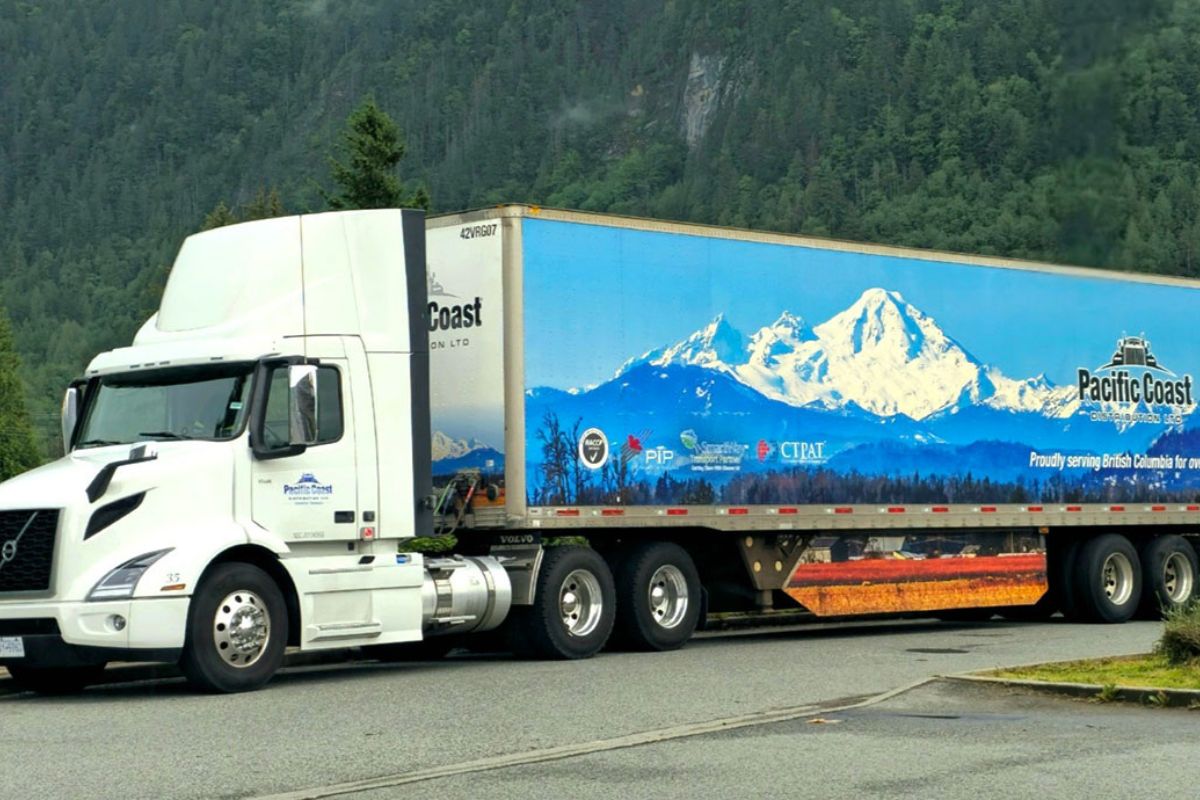
Pacific Coast Distribution runs an asset-based fleet, which means our own trucks and trailers, our own drivers, and our own maintenance shop on site in Calgary. When something needs to change mid-route, we can change it rather than relaying a request through a third party. Our transportation services cover LTL, FTL, regional delivery, tractor service and local drayage out of the same operation.
Talk to Our Calgary Team
We have served Western Canada for more than two decades, and our Calgary facility at 510 Carmek Blvd in Rocky View County is a HACCP and SQF certified, food grade operation with 17 dock level doors and an 8 acre secure site. We handle food, beverage, consumer packaged goods, healthcare, beauty, and appliances and electronics.
If you are shipping partial loads around Alberta and suspect you are paying too much, tell us what you move and how often. Call 1-877-999-8489 or request a rate quote.