

 1-877-999-8489


2026
Flat Deck and Over-Dimensional Freight in Calgary
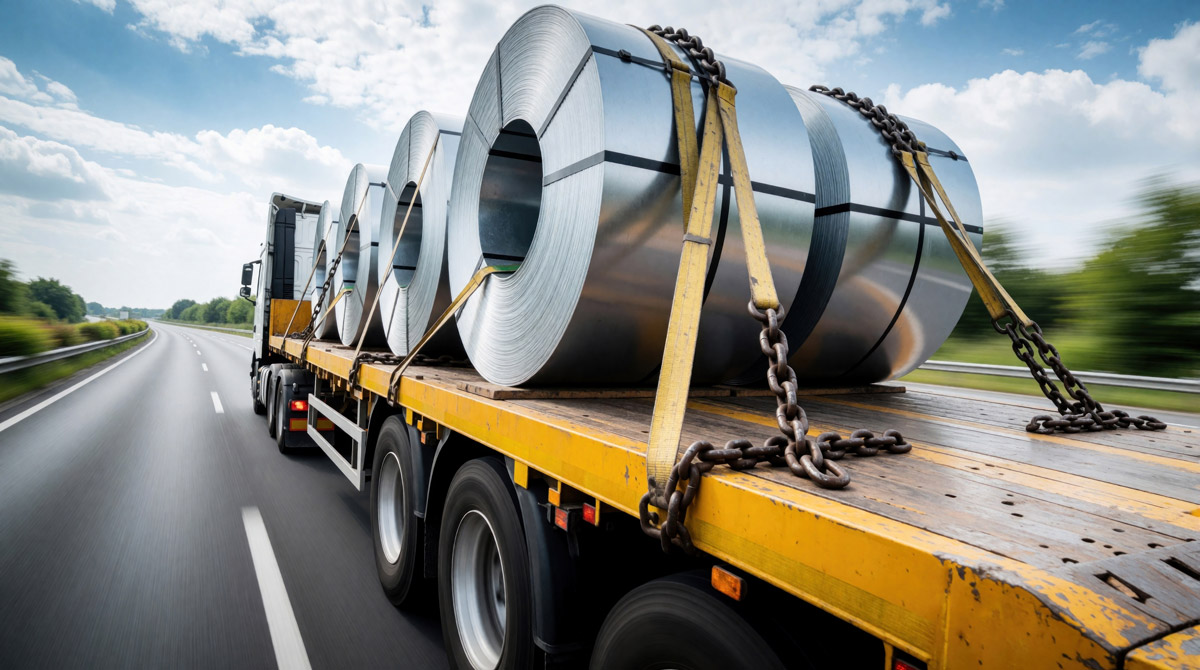
Some freight cannot be put on a dry van. Not because it is too heavy in total, but because it will not fit through a dock door, cannot be loaded from the rear, or has a shape that does not sit inside a box without wasting most of the trailer.
Structural steel, pipe, pre-cast concrete, modular building sections, agricultural implements, drilling and process equipment, transformers, generators, long lumber and packaged machinery all end up on open deck equipment for one of those reasons. Calgary sees a lot of it, because the industrial and energy base around the city both produces and consumes equipment at that scale.
What Flat Deck Equipment Does Differently
The defining feature is that the load is secured to the deck rather than contained by walls. That changes almost everything about how the move is planned.
Loading happens from the side or from above, by crane or forklift, which means both ends of the move need the right equipment and enough room to use it. Securement becomes an engineering question rather than a matter of closing a door. And the load is exposed, so anything sensitive to weather needs tarping, which adds time and cost and is physical work in an Alberta winter.
The equipment choice follows the dimensions. A standard flat deck handles most freight that is simply too wide or awkward for a van. A step deck lowers the rear portion of the trailer to gain height clearance. A double drop or lowboy drops it further still for tall machinery, and multi-axle configurations spread very heavy loads across more axles to stay inside allowable weights. Choosing the wrong one usually means discovering a clearance problem after the load is already secured.
Securement Is Not Optional and Not Approximate
Cargo securement on Canadian highways follows a national standard, and enforcement at inspection stations is routine rather than occasional. The requirements cover the number of tiedowns, the working load limit of each, how that limit relates to the weight of the article, blocking and bracing, and specific rules for commodities like metal coils, pipe, logs and machinery.
For a shipper this has two practical consequences. The first is that securement time is real time, and a schedule that assumes a flat deck loads as fast as a van will be wrong. The second is that the carrier has to be allowed to do it properly. A driver who refuses to leave until a load is correctly secured is protecting your freight and your liability, not being difficult.
When the Load Becomes Over-Dimensional
Freight crosses into permit territory once it exceeds the dimensions allowed for ordinary travel, which in Canada generally means wider than 2.6 metres, higher than 4.15 metres, or longer than the limits set for the trailer configuration, with weight limits applying separately.
Past those thresholds the move needs a permit from the province, and the permit is not a formality. It specifies the route, and it can attach conditions that shape the entire schedule:
- Approved routing that avoids specific structures, underpasses and urban sections, which may be considerably longer than the direct route
- Travel time restrictions, commonly daylight hours only and outside peak periods, with some loads restricted to specific days
- Pilot or escort vehicles, with the number increasing as width increases, and police escort for the largest moves
- Signage, flags and lamps on the load itself
- Utility or structure coordination where a tall load requires lines to be lifted or traffic to be held
- Engineering review for very heavy loads, confirming that bridges on the route can carry the axle loading
Each of those takes lead time. A simple over-width permit can often be arranged quickly. A heavy load needing a route survey and a structural assessment is a planning exercise measured in weeks, and the single most common cause of a missed delivery date is starting that process late.
The Alberta Specifics Worth Planning Around
Two local factors affect open deck freight more than shippers from outside the province expect.
Seasonal weight restrictions come first. When frost leaves the ground in spring, Alberta applies reduced axle weight limits on affected roads to protect the surface. A heavy load that is legal in February may not be legal in April on the same route, and the restriction is announced on relatively short notice. Industrial moves are often scheduled around this deliberately, either before breakup or after restrictions lift.
Winter is the other. Tarping a load at minus twenty takes longer, mountain corridors west of Calgary close without warning, and an over-dimensional permit restricted to daylight hours is a meaningful constraint in December. Building slack into the schedule is cheaper than paying for a crane crew that stands idle.
What to Have Ready Before You Ask for a Rate
Open deck quoting falls apart on missing information, and the gaps are always the same ones.
A carrier needs actual dimensions rather than nominal ones, including anything that protrudes, and the real weight rather than an estimate. It needs to know the centre of gravity and the lift points for anything that will be craned, and whether the article can be laid down or must travel upright. It needs to know what equipment is available at each end, because a site with no crane and no forklift of sufficient capacity changes the entire plan. And it needs the delivery site conditions, including access, ground surface and turning room, since many over-dimensional problems occur in the last two hundred metres.
Where freight has to be staged, consolidated or held between legs, a yard and dock capacity matter as much as the trailer. Our cross-docking capability and gated storage yard let a load sit securely between a rail arrival and a site that is not ready for it, which is frequently the practical constraint on a project move.
Our Calgary Fleet and Facility
18 Wheels has operated as a Canadian carrier and warehouse operator since 1989. Our transportation services include over-dimensional and flat deck, full truckload and less-than-truckload, container drayage and intermodal, run out of a Rocky View County facility with over 200,000 square feet of warehousing, more than 30 loading docks and a gated yard.
That combination is what lets a project move be staged rather than timed perfectly. The facility is one of more than ten locations across our network, so freight moving beyond Alberta stays with one carrier.
Send us the dimensions, the weight, the origin and destination, and the equipment available at each end. We will tell you what it needs, what permits it will require and how long that takes. Call 587-332-5252 or get in touch.